7 minute read -
Cutting Sandwich Panels: Which Saw to Use and How to Prevent Rust
Cut sandwich panels with a circular saw at a low speed, fitted with a blade designed for thin steel sheet and sandwich panels. Do not use an angle grinder: it burns the coating and the sparks leave rust spots. Brush all the metal particles off the panel as soon as you have finished cutting.
Cutting sandwich panels neatly means dealing with two materials in one pass. With the right blade and a few simple habits, the cut edge stays clean and the roof stays free of rust marks.
What will you learn in this article?
- What is a sandwich panel and why is it tricky to cut?
- Which saw is best for sandwich panels?
- Which saw blade should you use for sandwich panels?
- Why should you not use an angle grinder?
- How do you cut a sandwich panel step by step?
- How do you prevent rust and burrs after cutting?
- How do you cut out openings and round holes?
- Which safety precautions should you take?
- Common mistakes
- Frequently asked questions about cutting sandwich panels
- In short: cutting sandwich panels
What is a sandwich panel and why is it tricky to cut?
A sandwich panel, also called an insulated or composite panel, consists of two thin coated steel sheets with an insulating core between them, usually PIR, PUR or mineral wool. You see them as roof panels on outbuildings, carports and sheds, and as wall cladding.
When you cut one, you are dealing with two materials at once. The steel has to be cut cleanly without damaging the coating. The core has to be cut straight through without the foam tearing or the bond between core and steel coming loose. That is why not every saw works.
Which saw is best for sandwich panels?
| Saw | Suitable for | Note |
|---|---|---|
| Circular saw with panel blade | Straight cuts across the full width | Best choice for most jobs |
| Jigsaw with metal-cutting blade | Cut-outs, short cuts, curves | Slower, choose a long blade that reaches through the full thickness |
| Reciprocating saw with metal blade | Rough trimming, demolition | Not very accurate |
| Angle grinder | Not suitable | Burns the coating, sparks cause rust |
A cordless circular saw from the Maxxpack 18V range is handy on a roof or scaffold because you do not need an extension lead. Always check that the saw's maximum cutting depth, listed in its specifications, is enough for the thickness of the panel. If the panel is thicker, cut from both sides or use a saw with a greater cutting depth.
Which saw blade should you use for sandwich panels?
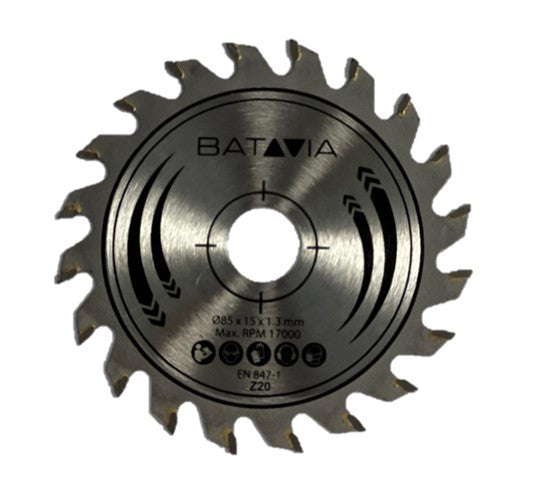
Use a dedicated blade for sandwich panels or thin steel sheet. These blades have fine teeth and are designed to cut through steel at a low speed without the steel getting hot. An ordinary wood-cutting blade blunts quickly and leaves burrs on the edge.
Panel blades come in various diameters. Choose one that fits your circular saw: the diameter and bore must match what the manufacturer of your saw specifies.
Why should you not use an angle grinder?
Sandwich panel manufacturers almost always advise against an angle grinder. There are three reasons:
- The high speed heats the steel. This burns the coating along the cut and can make the adhesive between steel and core let go.
- The sparks are glowing particles of steel. They burn into the panel's coating and rust there later on.
- With a PIR or PUR core, the heat causes scorch marks and fumes.
If you use an angle grinder anyway, the warranty on the coating is often void. Check the installation instructions for your panels to see what the manufacturer specifies.
How do you cut a sandwich panel step by step?
Measure and mark
Measure the length and allow for the overhang at the gutter. Check the panel instructions for how far the panel should project. Mark the cutting line on the protective film with a marker pen and leave the film on until after cutting, as it prevents scratches.
Support the panel
Lay the panel on a flat surface and support it on both sides of the cutting line so it does not sag or snap. Lay a roof panel with the ribs facing up, otherwise it will not sit steadily.
Fit a guide
Clamp a straight batten to the panel as a guide for the base plate of the saw.
Make the cut
Let the saw reach full speed before the blade touches the steel. Cut in one even movement without forcing the saw or stopping halfway. On a panel with high ribs, cut the flat sections first and then the ribs, or cut the ribs separately with a jigsaw.
How do you prevent rust and burrs after cutting?
The fine steel particles released while cutting are the biggest risk. Leave them lying there and after a few showers you will see small rust spots on your roof.
- Brush the metal filings away with a soft brush immediately after cutting. Do not wait.
- Only then remove the protective film.
- Remove burrs from the cut edge with a fine file.
- Where needed, touch up the cut edge with a repair paint in the colour of the panel, if the manufacturer recommends it.
Panel blades with fine teeth create fewer burrs, so there is less finishing work.
How do you cut out openings and round holes?
For a soil pipe or vent pipe passing through the panel, first drill a pilot hole with a metal drill bit. Then cut out the shape with a jigsaw fitted with a metal-cutting blade. Switch off the pendulum action and cut steadily. For round holes, a hole saw for metal also works, at a low speed.
Which safety precautions should you take?
- Wear cut-resistant gloves. The edges of cut steel are razor sharp.
- Wear safety glasses and ear protection.
- Wear a dust mask. Cutting PIR, PUR or mineral wool produces fine dust you do not want to breathe in.
- If you are working on a roof, use fall protection and preferably do your cutting on the ground.
- Remove the battery from the saw when changing the blade or adjusting the cutting depth.
Common mistakes
- Cutting with an angle grinder and letting sparks land on the panel.
- Cutting a panel that is not properly supported, so it buckles.
- Removing the protective film before cutting.
- Leaving metal filings on the panel until after installation.
- Using a wood-cutting blade that leaves burrs and blunts quickly.
Frequently asked questions about cutting sandwich panels
Can you cut sandwich panels with a jigsaw?
Yes, but it only works well for short cuts and cut-outs. Use a long metal-cutting blade that reaches through the full thickness and switch off the pendulum action. For long straight cuts, a circular saw with a panel blade is faster and straighter.
Which speed should you use?
Use a low speed. The steel then stays cooler and the coating stays intact. Follow the speed marked on the saw blade.
What should you do with the metal filings?
Brush them away immediately with a soft brush, before they get wet. Do not drag a magnet across the coating. Filings left lying on the panel rust and leave stains.
Which side should face up when cutting?
With a circular saw, the underside of the cut is usually the neatest, because the blade exits the material at the top. A profiled roof panel still goes ribs up, because otherwise it will not lie steadily. A fine panel blade and a low speed then keep the top face neat. Check what the installation guide for your panels recommends as well.
In short: cutting sandwich panels
Use a circular saw with a blade made for sandwich panels or thin steel, at a low speed, and keep the angle grinder in the shed. Support the panel well, cut in one steady pass along a guide and brush away every metal filing straight after cutting. Wear gloves, eye protection and a dust mask, and check old sheets for asbestos before you start.