7 minute read -
Cutting Timber Beams Square: How to Choose the Saw and Cut Straight
To cut a timber beam square, use a mitre saw if the beam fits within the saw's cutting capacity, and a circular saw or handsaw if it is larger. Always mark the cutting line all the way round with a try square, clamp the beam firmly and cut thick beams from two or more sides. That way the cuts meet neatly in the middle.
Cutting timber beams square is mostly about preparation. Accurate marking out and solid support do more for a clean, straight end than the saw itself.
What will you learn in this article?
- Which saw should you use to cut timber beams?
- How do you mark out a beam properly?
- How do you cut a beam square with a mitre saw?
- How do you cut a beam thicker than the cutting depth?
- When should you use a chainsaw for beams?
- What should you watch for with hardwood and old beams?
- Which saw blade should you choose for beams?
- How do you stop the beam splitting or pinching the blade?
- Safety when cutting timber beams
- Frequently asked questions about cutting timber beams
- In short: cutting timber beams square
Which saw should you use to cut timber beams?
The best saw depends on the size of the beam and how many cuts you need to make. Always check the maximum cutting depth or cutting capacity of your machine first, which you will find in its specifications.
| Saw | When to use it | Limitation |
|---|---|---|
| Mitre saw | Many identical cuts, square and mitred | Beam must fit within the saw's cutting capacity |
| Circular saw | Beams on site, longer lengths | Limited cutting depth, thick beams cut from two sides |
| Japanese pull saw or handsaw | Occasional cuts, no power, fine work | Takes time and practice on thick beams |
| Reciprocating saw | Rough cuts, demolition, beams with nails | Not very accurate |
| Chainsaw | Very thick beams and posts | Rough cut, needs experience and protective clothing |
If you work with the Maxxpack 18V battery platform, the same battery powers a cordless circular saw, a reciprocating saw and other tools. That is handy on scaffolding or in the garden with no socket nearby.
How do you mark out a beam properly?
A straight cut starts with accurate marking out. Measure the length and make a mark with a pencil or marking knife. Hold a try square against the best face of the beam and draw the line across. Turn the beam and mark all four sides, always working from the same reference face. If the lines meet exactly on the last side, your marking out is correct.
Then put a cross on the waste side. Always cut on the waste side of the line so your piece keeps the right length.
How do you cut a beam square with a mitre saw?
A mitre saw is the easiest way to cut beams square to length. Lay the beam flat against the fence and clamp it. Let the blade reach full speed and lower it steadily.
If the beam is slightly too thick or too wide for a single cut, you can cut it in two passes:
- Make the first cut as deep as the saw allows.
- Turn the beam 180 degrees along its length so the underside faces up.
- Place it against the same fence and line up the cutting line exactly.
- Make the second cut so it meets the first.
This only works if the beam is straight and square and sits firmly against the fence. If it is bowed or twisted, use another method.
How do you cut a beam thicker than the cutting depth?
A circular saw cannot cut deeper than the depth of its blade in one pass. With a thick beam you therefore cut from several sides:
- Mark all the way round as described above.
- Set the cutting depth to maximum and cut the first side along a guide rail or a clamped batten.
- Turn the beam and cut the opposite side. On a square beam you sometimes cut all four sides.
- If a core remains in the middle, finish it with a handsaw or reciprocating saw.
A simple jig makes this more accurate. Screw a straight batten square onto a piece of plywood and run the base plate of your circular saw against it. Clamp the jig to the beam and cut along the batten.
How do you get a straight cut with a handsaw?
A Japanese pull saw cuts on the pull stroke and has a thin blade, so it is less likely to wander off the line. Work like this:
- Score the marked line on at least three sides with a sharp knife.
- On the waste side, cut a small V-groove against the line. This gives the blade something to follow.
- Cut into one corner first, then the next side, turning the beam a quarter each time.
- Let the saw do the work and do not force it.
The saw then follows the grooves and the cut ends up square all round.
When should you use a chainsaw for beams?
For very thick beams, such as old oak roof timbers or garden posts, a chainsaw may be the only practical option. The cut will be rougher and less square, though. Only use a chainsaw if you are experienced with it, and wear chainsaw trousers, safety boots, gloves, a helmet with face shield and ear protection. Watch out for kickback: never cut with the upper tip of the guide bar.
What should you watch for with hardwood and old beams?
Oak and other hardwoods are harder to cut. Use a sharp blade and take your time. A blunt blade burns the wood and drifts off the line.
Old beams often contain nails, screws or staples. Check the cutting line with a metal detector or by eye before you start. A nail damages the saw blade and can send fragments of metal flying. A reciprocating saw with a bi-metal blade is a better choice in that case.
Which saw blade should you choose for beams?
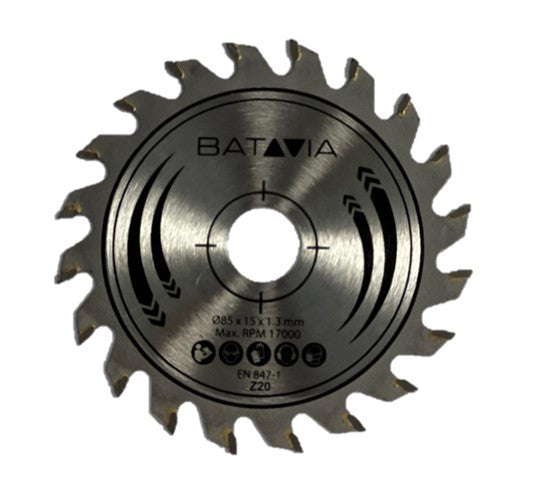
- Crosscutting (across the grain): a blade with many teeth gives a smooth cut.
- Ripping (along the grain): a blade with fewer, larger teeth clears the chips better.
- Timber with nails: a bi-metal reciprocating saw blade.
A fine blade cuts more neatly but more slowly. A coarse blade is faster, but you may need to sand or plane the cut afterwards.
How do you stop the beam splitting or pinching the blade?
Support the beam on both sides of the cutting line. If the offcut hangs free, it snaps off at the end of the cut and tears out the underside. If you support both sides too rigidly, the blade gets pinched. Make sure the offcut can drop away freely, or have someone hold it lightly without pulling.
Safety when cutting timber beams
- Wear safety glasses, ear protection and a dust mask.
- Always clamp the beam. Never hold it with your hand or knee.
- Keep your hands out of the line of the cut.
- Remove the battery or unplug the tool before changing the blade or adjusting the cutting depth.
Frequently asked questions about cutting timber beams
Can you cut a 10 x 10 cm beam with a mitre saw?
That depends on the cutting capacity of your mitre saw, so check its specifications. If the beam is just too big, you can cut it in two passes by turning it 180 degrees. That needs a straight beam and careful alignment.
How do you get a cut perfectly square?
Mark all the way round from one reference face and cut on the waste side of the line. Use a jig or guide with a circular saw. When cutting by hand, it helps to score the line first.
Which saw is fastest for thick beams?
A chainsaw is the fastest, but also the least accurate. For neat, square cuts, a circular saw used from two sides is usually the best balance of speed and precision.
What should you do if the saw jams in the beam?
Release the switch and wait until the blade has stopped. Support the beam so the kerf stays open and, if needed, tap a wedge into the cut. Never pull the saw free while it is running.
In short: cutting timber beams square
Mark the beam all the way round from one reference face, clamp it firmly and cut on the waste side of the line. Use a mitre saw for beams within its capacity, and a circular saw from two or more sides for thicker ones. Choose the blade to suit the grain and check old timber for nails before you start.