6 minute read -
Using a Multi-Tool for Laminate: What It Is Good For and What It Is Not
A multi-tool for laminate is most useful for small, precise jobs: undercutting door frames, making cut-outs and adjusting a floor that is already down. For cutting whole boards to length or ripping them, it is too slow and the blade wears quickly. For those cuts, use a mitre saw, circular saw, jigsaw or laminate cutter.
What will you learn in this article?
- How does a multi-tool work and why does it suit laminate?
- Which laminate jobs is a multi-tool good for?
- How do you undercut a door frame with a multi-tool?
- Which blade should you use for laminate?
- Why does the blade blunt so quickly?
- What speed should you use?
- How do you replace a damaged board in a laid floor?
- Multi-tool or jigsaw: which should you choose?
- Using a multi-tool safely
- Frequently asked questions about using a multi-tool for laminate
- In short: a multi-tool for laminate
How does a multi-tool work and why does it suit laminate?
A multi-tool does not spin. It moves the blade back and forth in small, rapid oscillations. That lets you push the front of the blade straight into the material (a plunge cut) and cut flush against a wall, door frame or floor. A jigsaw or circular saw cannot do that.
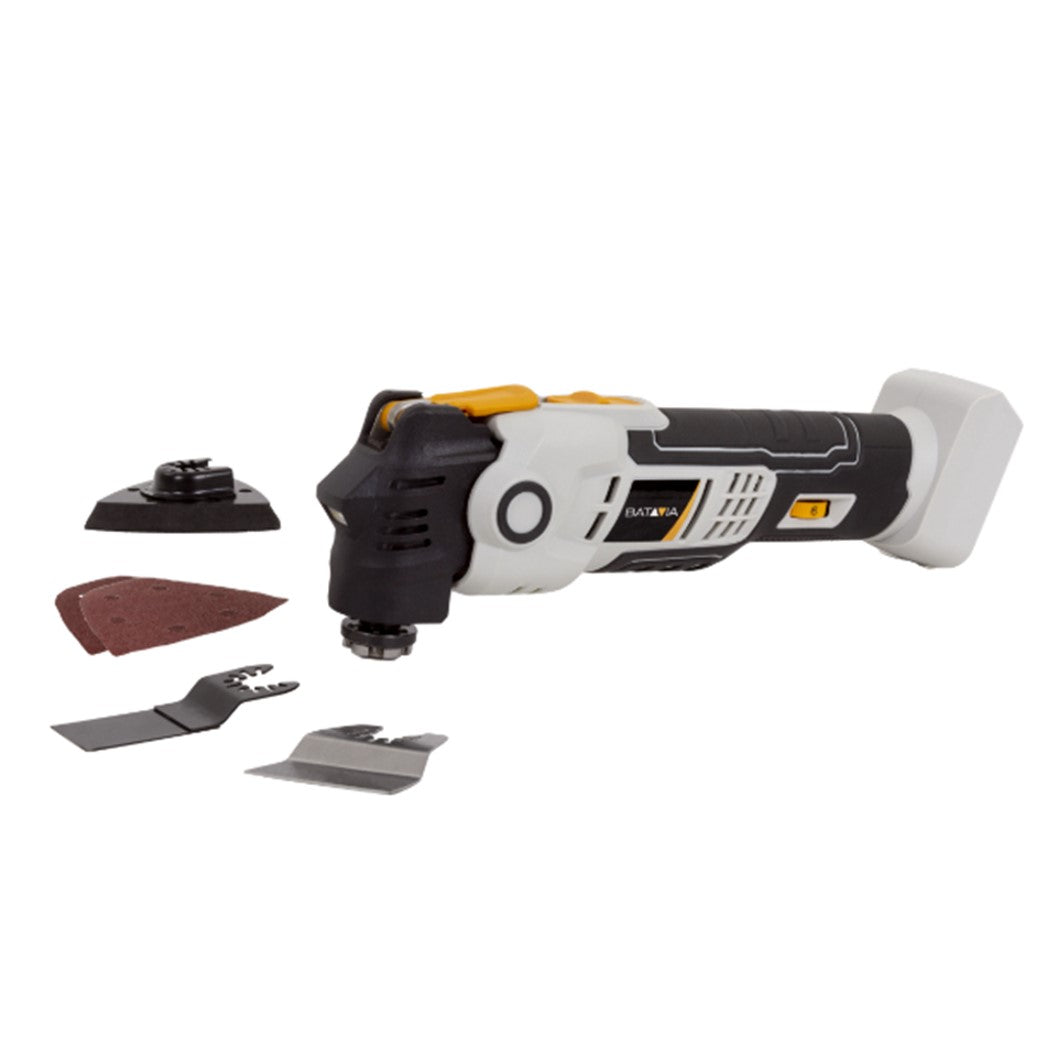
With laminate, this comes in handy wherever space is tight. With a sanding pad fitted, you can also tidy up small edges. A cordless multi-tool, for example from the Maxxpack 18V range, is practical because you often work on your knees in doorways and corners.
Which laminate jobs is a multi-tool good for?
- Undercutting door frames, so the board runs under the frame.
- Cut-outs around pipes, frame corners and stair treads.
- Adjustments in a laid floor, such as a piece that is just too long at a threshold.
- Cutting out a damaged board in the middle of the floor.
- Shortening skirting boards or trims that are already fixed in place.
How do you undercut a door frame with a multi-tool?
This is the job most people buy a multi-tool for. Instead of cutting the laminate to fit around the frame, you cut away the bottom of the frame. The board then slides underneath and there is no visible joint.
Make a height guide
Place a piece of underlay with an offcut of laminate on top against the door frame. Together they give you exactly the height of the finished floor.
Rest the blade on the offcut
Lay the blade flat on the offcut so it is level with the top of the new floor.
Cut into the frame
Fit a plunge-cut blade and cut steadily into the frame, using the offcut as a guide.
Check the fit
Remove the cut-off piece and check that a board with underlay slides easily underneath.
Leave a small expansion gap at the edge of the board under the frame so the laminate can still move. With stone frames or a concrete sill you need a different blade, or you leave the frame as it is and finish the edge with sealant or a trim.
Which blade should you use for laminate?
The top layer of laminate is extremely hard-wearing. Ordinary high-carbon steel (HCS) wood blades blunt quickly on it. So choose one of these:
| Blade type | Use with laminate |
|---|---|
| Bi-metal plunge-cut blade | Undercutting frames, straight plunge cuts, lasts longer than HCS |
| Carbide plunge-cut blade | Lots of work in laminate, longest blade life |
| Segment blade (round) | Long straight cuts in a laid floor, easier to keep straight |
| Sanding pad | Tidying up small edges and burrs |
Check the blade fitting too. Several mounting systems are in use, so look in your multi-tool's manual to see which blades fit your machine.
Why does the blade blunt so quickly?
Laminate has a top layer containing hard particles that protect the floor from wear. Those same particles wear down the teeth of your blade. On top of that, a multi-tool makes short strokes, so the same teeth stay in the material longer than on a circular saw.
To make your blade last longer:
- Do not push hard; let the blade do the work.
- Move the blade slightly from side to side in the cut, so the teeth do not keep wearing in the same spot and the dust can escape.
- Choose bi-metal or carbide rather than HCS.
What speed should you use?
For wood and laminate you usually use a high oscillation speed. Start a plunge cut slightly lower so the blade does not skip, then increase the speed once the blade is in the material. If the blade gets hot or you smell burning, turn the speed down a little and press more lightly. You will find the speed range of your machine in its manual.
How do you replace a damaged board in a laid floor?
With a floating floor, you can usually lift the boards from the wall up to the damaged one. If the board is in the middle of a large room, you can do it with a multi-tool:
- Using a segment or plunge-cut blade, cut a rectangle inside the board, a few centimetres in from the edges.
- Cut diagonally from the corners to the edges and carefully remove the pieces.
- Remove what is left of the tongue and groove.
- Cut the lower lip off the groove of the new board so you can drop it in from above.
- Glue the board into the joints and weigh it down until the glue has dried.
Work carefully: do not cut through the underlay and watch out for underfloor heating pipes.
Multi-tool or jigsaw: which should you choose?
A jigsaw is faster for cut-outs and curves in loose boards. A multi-tool wins as soon as you need to cut flush against something or work in a floor that is already down. For cutting to length and long cuts, a mitre saw and a circular saw with a guide rail are better. Our guide to cutting laminate explains which saw suits which cut, and our guide on how to install laminate flooring walks you through laying the floor itself.
Using a multi-tool safely
Clamp the workpiece or make sure it is stable. Wear safety glasses, ear defenders and a dust mask rated at least FFP2, because laminate dust is fine. Keep your fingers away from the blade: it oscillates so fast that you can barely see it move. Remove the battery before changing a blade, and do not touch the blade straight after cutting, as it can be hot.
Frequently asked questions about using a multi-tool for laminate
Can you cut a whole laminate floor with just a multi-tool?
Technically yes, but it takes a long time and a lot of blades. Straight cuts will also be less accurate. Use the multi-tool alongside a faster saw.
Which blade do I need to shorten a door frame?
A plunge-cut blade for wood, preferably bi-metal. Lay it flat on an offcut with underlay so you cut at exactly the right height.
Can I cut skirting boards with a multi-tool?
Yes, especially if the skirting is already fixed and you want to remove a section. For cutting new skirting to size and mitring it, a mitre saw is more accurate.
Why does the blade skip at the start of a plunge cut?
Usually the speed is too high or you are pressing the blade too hard against the material. Start at a lower speed, touch the blade on lightly and let it sink into the material steadily.
In short: a multi-tool for laminate
Use a multi-tool for the work other saws cannot do: undercutting door frames, plunge cuts and adjustments in a laid floor. Choose a bi-metal or carbide blade, do not press too hard, and cut whole boards with a mitre saw, circular saw or laminate cutter.