8 minute read -
Sanding a Car: Which Sander and Which Grit for Each Layer?
To sand a car, you will usually reach for a random orbit sander, because it works quickly and does not leave swirl marks in the paintwork. The grit depends on the layer: coarse (P80 to P180) for body filler and bare metal, medium (P320 to P500) for primer and for keying old paint, and very fine (P1500 to P3000), used wet by hand, for clear coat before polishing.
Whatever stage you are at, sanding a car always means working in steps from coarse to fine. Pick the right sander and grit for each layer and the new paint will lie flat without scratches showing through.
What will you learn in this article?
- Which sander is suitable for a car?
- Which grit should you use for each layer?
- Wet or dry sanding: what is the difference?
- How do you deal with rust and plastic parts?
- Sander or sanding by hand?
- How long does it take to sand a car panel?
- How do you sand safely?
- Step by step: sanding a car panel for new paint
- Common mistakes when sanding a car
- Frequently asked questions about sanding a car
- In short: sanding a car
Which sander is suitable for a car?
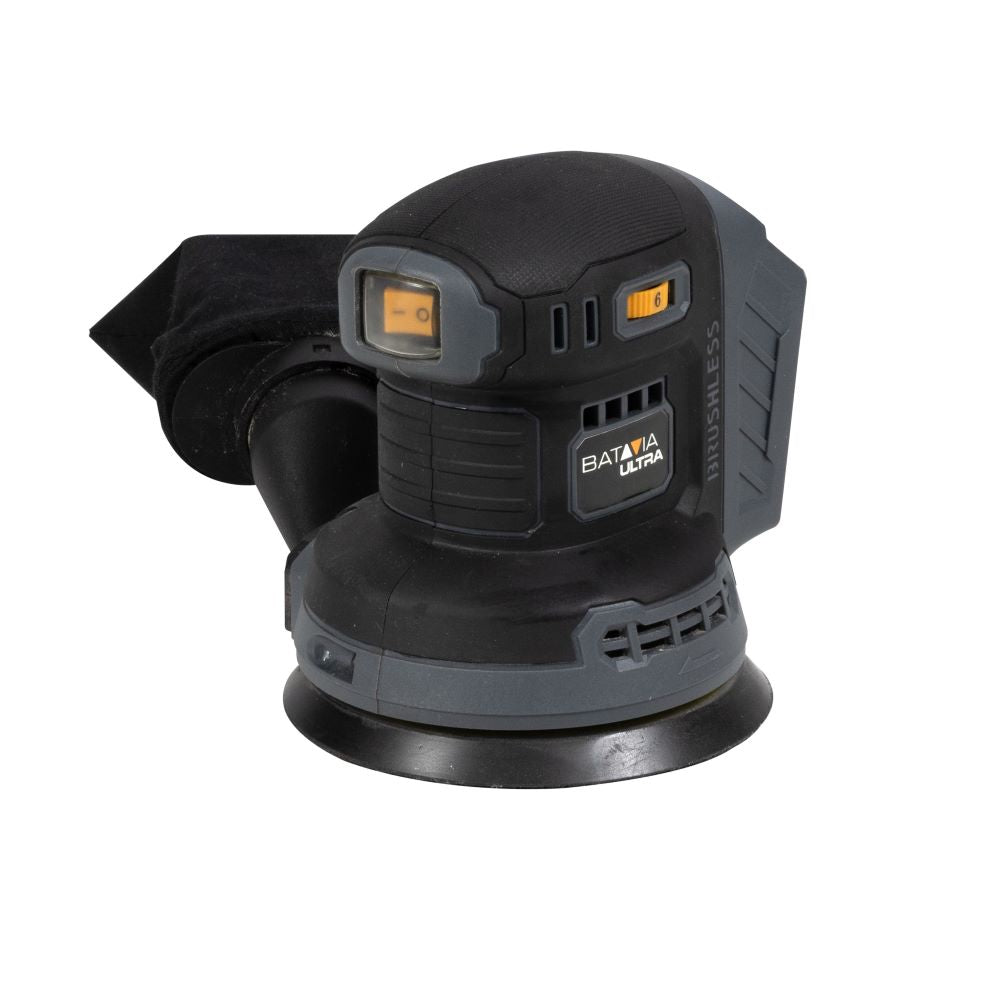
A random orbit sander is the best choice for bodywork. The pad spins and makes small orbits at the same time, which gives an even scratch pattern with no straight scratches in one direction. That matters, because every scratch you leave behind will show up again under the paint.
Other machines have their own role:
| Machine | When to use it on a car |
|---|---|
| Random orbit sander | Body filler, primer, keying old paint, large panels such as the bonnet and doors |
| Orbital sander | Flat panels, although the finish is less fine |
| Detail sander or multi-tool | Corners, edges and small areas around lights and handles |
| Angle grinder with a flap disc or wire brush | Only for heavy rust and taking metal back to bare, never on paint |
| Polisher | After sanding, to bring back the shine; it is not a sander |
With a random orbit sander, look at the orbit size. A small orbit gives a finer finish and suits primer and paint. A larger orbit removes material faster and is better for body filler. Check the specifications of the sander you are considering to see which orbit it has.
A cordless random orbit sander, for example from the Maxxpack 18V range, is handy around a car because you can walk round the vehicle without a cable dragging across the panels. If you are sanding a lot of filler, a sander with dust extraction or a connection for a vacuum makes the job far more pleasant.
Which grit should you use for each layer?
Always work from coarse to fine and do not skip a grit, or the deep scratches from the previous step will stay visible.
| Layer or job | Grits | Dry or wet |
|---|---|---|
| Rust and old paint back to bare metal | P80, then P120 | Dry |
| Shaping body filler | P80, P120, P180 | Dry |
| Preparing filler and edges for primer | P240 to P320 | Dry |
| Sanding primer or high-build primer before base coat | P400 to P500 dry, or P800 to P1000 wet | Dry or wet |
| Keying old paint for new paint | P400 to P500, edges with a scuff pad | Dry or wet |
| Dust nibs and runs in clear coat | P1500, P2000, P3000 | Wet, by hand |
For body filler
Shape the filler with P80 to P120 on a random orbit sander or a long sanding block. Then feather the edges with P180 and P240 so the repair blends smoothly into the old paint. Run the flat of your hand over the panel: your fingers pick up small high spots that your eyes miss.
For primer
Flat down primer or high-build primer with P400 to P500, dry. Apply a thin guide coat first, either a spray can in a contrasting colour or guide coat powder. Wherever the guide coat is still visible after sanding, there is a low spot you have not yet sanded flat.
For clear coat
Dust nibs, runs or orange peel in the clear coat come out with P1500 to P3000, used wet. After that, restore the gloss with a polisher and polishing compound. Take care here, because clear coat is thin. If you sand through it, the panel will need respraying.
Wet or dry sanding: what is the difference?
Dry sanding is for the heavier work: old paint, rust, body filler and primer. It is quicker and you see the result straight away. It does create a lot of dust, so you need extraction and a dust mask.
Wet sanding is for fine grits (P800 and finer). The water washes away the residue, so the paper clogs less quickly and the finish is finer. It also produces hardly any dust.
Can you wet sand with an electric sander?
No, not with an ordinary electric sander, and that includes cordless ones. Water and power tools do not mix and the sander is not built for it. Wet sand by hand, with waterproof abrasive paper on a soft sanding block and a spray bottle or a bucket of water. Professionals sometimes use air-powered sanders designed for wet sanding.
How do you deal with rust and plastic parts?
Rust: sand or brush away all the rust until you see bright metal, with a generous margin around it. If you leave brown specks in pits, the rust will come back under the new paint. Prime bare metal with a suitable primer as soon as possible. If the panel has rusted through, it needs welding or a new panel; body filler is not a repair for metal with holes in it.
Plastic bumpers: use finer grits (from P320) and light pressure, because plastic heats up quickly and can go fluffy. On bare plastic, use an adhesion promoter or primer made for plastics.
Sander or sanding by hand?
A sander is quicker and gives a more even result on large panels. It is also much easier on your arm and shoulder. You still need to sand by hand for:
- curves, swage lines and edges where a sander would remove too much;
- wet sanding clear coat;
- small spots, using a sanding block.
A combination works best: large panels with the random orbit sander, details by hand or with a detail sander.
How long does it take to sand a car panel?
That depends on the damage and the number of layers. A small filler repair can be sanded in an hour. Keying a whole bonnet for new paint takes a few hours. On top of that, allow for the drying times of filler and primer between steps; you will find them on the packaging.
How do you sand safely?
- Wear a dust mask rated at least FFP2, preferably FFP3 for filler and old paint, plus safety glasses and gloves.
- Older cars may have paint containing lead or chromates. Do not dry sand it without good extraction, work wet as much as possible and keep the dust out of the house.
- Work in a ventilated space and away from naked flames, especially when degreasing with solvent.
- Remove the battery from the sander before changing the abrasive.
- Mask off windows, rubber seals and lights with tape and sheeting so you do not sand them by accident.
Step by step: sanding a car panel for new paint
Wash and degrease
Wash the panel and degrease it with a silicone remover. Otherwise sanding pushes grease and wax into the paint.
Mask off
Tape and sheet everything that will not be sanded or painted.
Rough sanding
Take rust, old paint and filler down with P80 to P180.
Feather the edges
Sand edges and transitions with P240 to P320 so the repair blends in.
Prime and sand
Apply primer and, once it is dry, flat it down with P400 to P500.
Remove dust and degrease again
Blow or wipe off the dust and degrease once more just before you spray.
Common mistakes when sanding a car
- Skipping grits, so scratches stay visible under the paint.
- Pressing too hard; let the sander do the work.
- Tilting the sander, so the edge of the pad digs in and leaves dips.
- Staying in one place for too long, especially on edges and swage lines where the paint is thin.
- Not degreasing before sanding.
- Sanding too coarsely on paint that only needs keying.
Frequently asked questions about sanding a car
Which sander is best for paint damage on a car?
A random orbit sander with a small orbit. It gives a fine finish and does not leave swirl marks. For the corners around handles and lights, use a detail sander or sand by hand.
Which grit should you use to key car paint?
For a new base coat, you usually key with P400 to P500. Do edges and corners with a scuff pad. Do not use paper that is too coarse, because scratches from P220, for example, often show through a thin coat of paint.
Can I sand out scratches in the paint?
Light scratches that are only in the clear coat can be wet sanded out with P2000 to P3000 and then polished. If you can clearly feel the scratch with your fingernail, it is usually too deep. Then it needs a local touch-up or a respray.
Can I sand a car with a sander meant for wood?
Yes, a random orbit sander you use for wood also works on a car. The difference is mainly in the abrasive: choose sanding discs suitable for paint and metal, with a hole pattern that matches your sander's dust extraction.
In short: sanding a car
For bodywork, a random orbit sander is the most useful machine, backed up by hand sanding for curves, edges and wet work. Work from coarse to fine without skipping grits: P80 to P180 for filler and bare metal, P400 to P500 for primer and keying, and P1500 to P3000 wet for clear coat. Degrease before and after sanding, and protect yourself from dust.