6 minute read -
Types of Sanders: Which Sander Should You Choose for Each Job
There are five common types of sanders for DIY use: the detail sander for corners, the orbital sheet sander for flat surfaces, the random orbit sander for large areas and a fine finish, the belt sander for removing a lot of material quickly, and the multi-sander, which combines several pads in one tool. For walls and ceilings there is also the long-handled drywall sander.
Which one you choose depends on the surface, the shape of the workpiece and how much material needs to come off.
What will you learn in this article?
- Which sander suits which job?
- Detail sander: for corners and details
- Orbital sheet sander: the all-rounder for flat surfaces
- Random orbit sander: for large surfaces and a fine finish
- Belt sander: for heavy work
- Multi-sander: several pads in one tool
- Drywall sander: for walls and ceilings
- Which grit should you use?
- Cordless or corded?
- What should you look for when buying?
- Cleaning the surface after sanding
- Safety
- Frequently asked questions about types of sanders
- In short: types of sanders
Which sander suits which job?
| Job | Best choice | Alternative |
|---|---|---|
| Window frames and corners | Detail sander | Multi-sander |
| Doors and cupboard doors | Orbital sheet sander or random orbit sander | Multi-sander |
| Stripping a table top or furniture | Random orbit sander | Belt sander for thick layers |
| Old paint on a flat surface | Belt sander | Random orbit sander with coarse grit |
| Smoothing scaffold boards | Random orbit sander | Belt sander |
| Plasterboard and filler | Drywall sander | Orbital sheet sander with sanding mesh |
| Wooden floor | Drum or belt floor sander (hire) | Random orbit sander for small areas |
Detail sander: for corners and details
A detail sander has a triangular pad shaped like the base of an iron. With the tip you can reach into the corners of window frames, the rebate next to glazing beads and between the spindles of a staircase. The pad vibrates in small movements, so the sander removes little material and is easy to control. It is too small for large surfaces: you would be at it for a long time.
Orbital sheet sander: the all-rounder for flat surfaces
An orbital sheet sander has a rectangular pad that vibrates in small circles. Thanks to its straight edges, you can reach into the corner of a panel and along an edge. It suits doors, cupboards, skirting boards and window frames and gives an even result. It removes material more slowly than a random orbit sander, so it is less suited to stripping a large surface.
Random orbit sander: for large surfaces and a fine finish
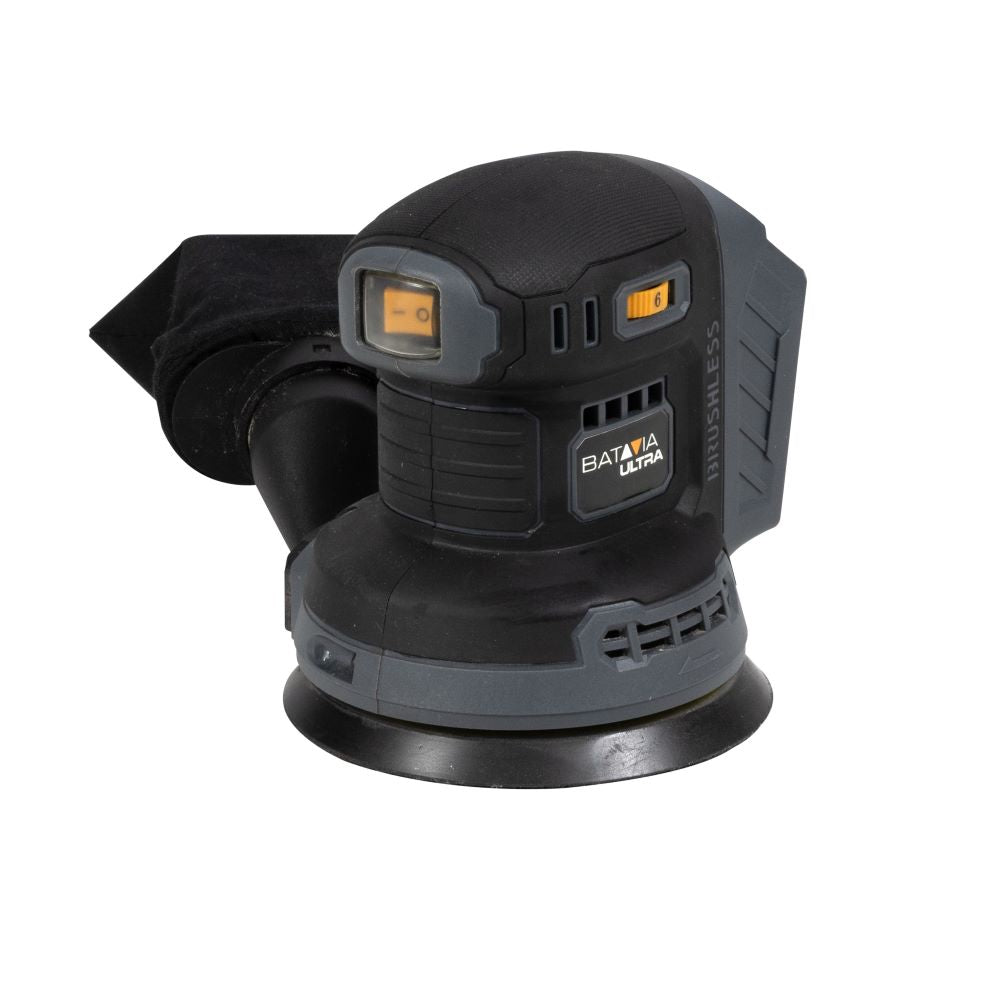
A random orbit sander has a round sanding disc that spins and makes a small eccentric movement at the same time. This means it does not leave a regular scratch pattern and the surface becomes very smooth. With a coarse grit you remove paint or varnish quickly; with a fine grit you finish or polish. It also works on slightly curved surfaces. It cannot reach into sharp corners because the disc is round.
Belt sander: for heavy work
A belt sander has a continuous sanding belt that runs fast in one direction. It removes a lot of material in a short time and is suited to thick layers of paint, rough timber and levelling large boards or a worktop. Work along the grain and keep the sander moving at all times. If you stay in one place, you will sand a dip into the surface. A belt sander is not designed for fine finishing.
Multi-sander: several pads in one tool
A multi-sander has interchangeable pads, for example a triangle for corners and a rectangle for flat areas. It is handy if you want one tool for all sorts of small jobs around the house. For lots of heavy sanding on large surfaces, a separate random orbit sander is the better choice.
Drywall sander: for walls and ceilings
A drywall sander, sometimes called a giraffe sander, has a round sanding head on a long pole and connects to a dust extractor. You use it to sand filler on plasterboard and walls without needing scaffolding. It is not suitable for woodwork.
Which grit should you use?
- P40 to P60: removing old paint, varnish or rough timber quickly.
- P80 to P120: smoothing after the coarse work, sanding scaffold boards.
- P150 to P180: keying existing paint before a new coat.
- P240 and finer: sanding between coats of varnish.
Sand from coarse to fine and do not skip a grit. Each step removes the scratches from the previous one. If you start too fine, the paper wears out quickly and you make little progress.
Cordless or corded?
A cordless sander is handy for jobs outdoors, on a ladder or in a room without a socket. If you already use the Batavia Maxxpack 18V platform, you can use the same batteries as in your drill or saw. For hours of continuous sanding, a corded sander or a second battery is more practical, because sanding draws power constantly.
What should you look for when buying?
- Dust extraction: a dust bag or a port for a vacuum keeps the abrasive and your workspace cleaner.
- Abrasive fixing: hook-and-loop is quicker to change than clamps.
- Variable speed: lower for soft materials and plastics, higher for hardwood.
- Weight and grip: important if you sand overhead or for long periods.
- Abrasive size: check that replacement sheets or discs are easy to get.
Cleaning the surface after sanding
Brush off the coarse dust with a soft brush or a vacuum with a brush attachment. Then wipe the surface with a slightly damp cloth or a tack cloth to remove the fine dust. Let it dry before painting or varnishing. Any dust left behind will show up as specks in the paint.
Safety
Wear a dust mask with an FFP2 filter, safety glasses and, for long sessions, ear protection. Hardwood dust and filler dust are harmful to breathe in. Remove the battery or unplug the sander before changing the abrasive.
Frequently asked questions about types of sanders
Which sander is the most versatile?
For most DIYers a random orbit sander is the most versatile choice, combined with a detail sander for corners. If you only want one tool, look at a multi-sander with interchangeable pads.
What is the difference between an orbital sheet sander and a random orbit sander?
An orbital sheet sander has a rectangular pad and reaches into corners. A random orbit sander has a round disc, removes material faster and gives a smoother finish, but does not reach into corners.
Do I need a belt sander?
Only if you regularly remove thick layers of paint or want to level rough timber quickly. For keying and finishing, a random orbit sander is gentler and easier to control.
Can I use one sander for both wood and walls?
For small patches of filler, an orbital sheet sander with sanding mesh will do. For whole walls and ceilings, a drywall sander is much faster and cleaner.
In short: types of sanders
A detail sander handles corners, an orbital sheet sander handles flat surfaces and a random orbit sander covers large areas and fine finishing. Choose a belt sander for heavy stripping, a multi-sander if you want one tool for small jobs and a drywall sander for walls and ceilings. Match the grit to the job and always protect yourself against dust.