6 minute read -
Cutting Douglas Fir: The Right Saw, the Right Blade and Practical Tips
The best way of cutting Douglas fir is with a tungsten carbide (TCT) wood blade: one with fewer teeth for fast, rough work and one with more teeth for a clean, splinter-free edge. For boards and battens a circular saw or mitre saw works well.
For thick posts and beams, use a circular saw with enough cutting depth or a reciprocating saw. Watch out for resin and hard knots, and keep the blade sharp and clean.
What will you learn in this article?
- What kind of timber is Douglas fir?
- Which saw should you use for Douglas fir?
- Which blade should you use for Douglas fir?
- How do you cut Douglas fir without splintering?
- How do you cut thick Douglas fir beams and posts?
- What should you do about resin on the blade?
- Can you cut wet Douglas fir?
- How should you treat the cut edges?
- How to cut Douglas fir safely
- Frequently asked questions about cutting Douglas fir
- In short: cutting Douglas fir
What kind of timber is Douglas fir?
Douglas fir is a softwood that is popular for fencing, garden buildings, pergolas, decking and cladding. It is a little harder and stronger than spruce (whitewood) or pine (redwood), but still easy to work. A few properties affect how it cuts:
- Resin: Douglas fir contains resin, which sticks to the blade. A dirty blade runs hot and cuts poorly.
- Knots: the knots are harder than the surrounding wood. The blade can snag or wander there.
- Splintering: the fibres are long and the edges can tear out, especially on sawn timber.
- Moisture: Douglas fir is often sold still fairly wet. Wet timber is harder to cut and can pinch the blade.
So the old idea that Douglas fir is soft and easy to cut is only half true. With the right blade it is straightforward; with a blunt or wrong blade you get ragged edges.
Which saw should you use for Douglas fir?
| Job | Suitable saw |
|---|---|
| Cutting boards and battens to length | Mitre saw or circular saw |
| Angles and mitres | Mitre saw |
| Long rip cuts | Circular saw with guide rail or parallel fence |
| Thick beams and posts | Circular saw with a large cutting depth, cutting from two sides, or a reciprocating saw |
| Curves and cut-outs | Jigsaw with a wood blade |
| A single cut without power | Handsaw with coarse teeth |
A cordless circular saw or mitre saw from the Maxxpack 18V range is handy in the garden, where there is often no socket nearby. If you are building a garden structure, our guide to building a wooden patio cover shows the whole project.
Which blade should you use for Douglas fir?
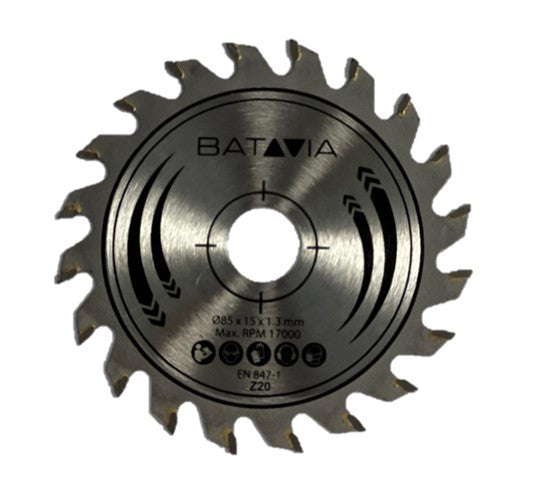
Use a tungsten carbide-tipped (TCT) wood blade. These stay sharp much longer than steel blades and cope better with resin and knots.
- Few teeth (coarse): for fast cutting of construction timber, posts and rip cuts. The blade clears sawdust well and is less likely to pinch.
- Medium number of teeth: a good all-round choice for fence boards and framing.
- Many teeth (fine): for planed Douglas fir, cladding and visible work where a crisp edge matters.
The exact number of teeth depends on the blade diameter: a larger blade has more teeth for the same application. Check the packaging to see what the blade is designed for. In a jigsaw, use a coarse wood blade for thick timber and a fine blade for clean edges.
How do you cut Douglas fir without splintering?
- Put the good face the right way. With a circular saw or jigsaw, the top face tears out most, so place the good face down. With a mitre saw, the good face goes up.
- Tape along the cutting line with masking tape when cutting planed timber.
- Do not rush. Let the blade do the work, especially through knots.
- Support the offcut so it does not snap off and tear the last fibres.
- Use a sharp blade. A blunt blade tears the fibres rather than cutting them.
How do you cut thick Douglas fir beams and posts?
Douglas fir posts and beams are often thicker than the cutting depth of a standard circular saw. Mark the cutting line all the way round with a try square. Then cut in from two or four sides so the cuts meet exactly. A reciprocating saw with a long wood blade helps to finish the last section. Rest the beam securely on trestles and stop the cut from closing up: support both sides or cut so the offcut can fall away freely.
What should you do about resin on the blade?
Resin makes the blade drag and run hot, which leaves burn marks on the timber. Remove the battery or unplug the saw, take the blade off and clean it with a resin remover and a soft brush. Do not use a wire brush on the carbide teeth. Let the blade dry thoroughly before refitting it.
Can you cut wet Douglas fir?
Yes, but it is harder work. Wet timber creates more friction and the cut can close up. Choose a blade with fewer teeth, cut steadily and keep long cuts open with a wedge. Bear in mind that wet Douglas fir will shrink a little as it dries and may crack, so do not cut it to the exact millimetre while it is still wet.
How should you treat the cut edges?
A freshly cut surface, especially end grain, soaks up a lot of moisture. Outdoors, that is where the wood cracks and rots first. Lightly sand the edge and treat the end grain with a stain, oil or end grain sealer, just like the rest of the timber. This matters even more for posts set in the ground, as Douglas fir does not last as long there as hardwood.
How to cut Douglas fir safely
Wear safety glasses, ear defenders and, if there is a lot of dust, a dust mask. Douglas fir splinters, so wear work gloves when handling the timber, but not when using a saw where a glove could catch in the blade. Clamp the workpiece and keep your hands out of the line of cut.
Frequently asked questions about cutting Douglas fir
Is Douglas fir a hardwood or a softwood?
Douglas fir is a conifer, so it counts as a softwood. It is harder and stronger than spruce and pine, though. A TCT wood blade cuts it without any trouble.
How many teeth should a blade for Douglas fir have?
That depends on the blade diameter and the job. Choose fewer teeth for fast, rough work and more teeth for a neat edge. The blade packaging usually states what it is designed for.
Why is my blade burning the Douglas fir?
Usually the blade is blunt or coated in resin. Cutting too slowly or a cut that closes up also causes friction and burn marks. Clean the blade, check that it is sharp and support the timber properly.
Can I cut Douglas fir with a jigsaw?
Yes, for curves, cut-outs and thin boards. Use a wood blade that is long enough for the thickness of the timber. For straight cuts in thick timber, a circular saw is faster and more accurate.
In short: cutting Douglas fir
Douglas fir cuts easily with a sharp TCT wood blade: fewer teeth for speed, more teeth for a clean finish. Use a mitre saw or circular saw for boards, cut thick posts from several sides and keep the blade free of resin. Seal the cut ends before the timber goes outside.