6 minute read -
Mitre Saws: What They Are, Which Type to Choose and How They Work
A mitre saw is a saw mounted on a fixed base that cuts wood and other materials quickly and accurately, either square or at an angle. You lower the spinning blade from above through the workpiece, which rests against a fence.
The mitre function lets you cut angles, and a sliding function lets you cut wider boards as well.
What will you learn in this article?
- What is a mitre saw and what is it used for?
- What types of mitre saw are there?
- What does the sliding function do?
- What can you cut with a mitre saw?
- How does a mitre saw work?
- Which blade should you use in a mitre saw?
- What to look for when choosing a mitre saw
- Mitre saw or circular saw?
- How to use a mitre saw safely
- Frequently asked questions about mitre saws
- In short: mitre saws
What is a mitre saw and what is it used for?
A mitre saw (the simplest version is often called a chop saw) cuts long lengths of material to size. Think of skirting boards, battens, floorboards, joists, mouldings and door frames. Because the saw head is fixed to a pivot, every cut is straight and it is easy to repeat the same length.
Typical jobs:
- Cutting mitres on skirting boards and mouldings
- Cutting floorboards and laminate to length
- Cutting studs and timber to size for a stud wall or pergola
- Making picture frames and boxes with 45-degree corners
- Cutting decking or fence boards to size
What types of mitre saw are there?
The names are often mixed up. This is the difference:
| Type | What can it do? | Suitable for |
|---|---|---|
| Chop saw | Square cuts only | Cutting battens and boards to length |
| Mitre saw | Turntable for angles to the left and right | Skirting boards, mouldings, frames |
| Compound mitre saw | Turntable plus a tilting saw head | Angled cuts in two directions, such as coving and roof timbers |
| Sliding mitre saw | Saw head slides on rails | Wide boards, floorboards, panels |
So a sliding mitre saw is not just another name for a mitre saw. It is a mitre saw with a sliding function.
What does the sliding function do?
On a saw without a slide, the cutting width is limited to what the blade can cut in one plunge. With a slide, the saw head runs on rails. You pull the running saw towards you, lower it and then push it steadily back through the workpiece. That way you can cut boards much wider than the blade itself, which is handy for floorboards, wide boards and stair treads. A sliding mitre saw does take up more room, because the rails stick out at the back.
What can you cut with a mitre saw?
- Wood and sheet material: solid timber, MDF, plywood and chipboard, provided it fits under the saw.
- Laminate and vinyl flooring: a fine blade gives a clean edge.
- Plastic: PVC profiles, pipes and trims, with a suitable blade and at a steady pace.
- Aluminium and other non-ferrous metals: only with a dedicated non-ferrous blade and only if the saw manufacturer allows it. Always clamp the workpiece firmly.
Do not cut steel with an ordinary mitre saw. For that you need a metal cut-off saw or an angle grinder.
How does a mitre saw work?
- Set the saw up firmly on a workbench or stand. Support long lengths on both sides.
- Set the angle. Turn the table to the mitre angle you want and tilt the saw head if needed. Tighten the locks firmly.
- Place the workpiece against the fence and clamp it with the clamp supplied with the saw.
- Switch on the saw and wait until the blade reaches full speed.
- Lower the saw head steadily and cut without forcing it. On a sliding mitre saw, pull the head towards you first and then push it through the workpiece.
- Release the trigger and wait until the blade has stopped before raising the head.
Many mitre saws also have a depth stop, so you can cut partway through to make grooves or notches.
Which blade should you use in a mitre saw?
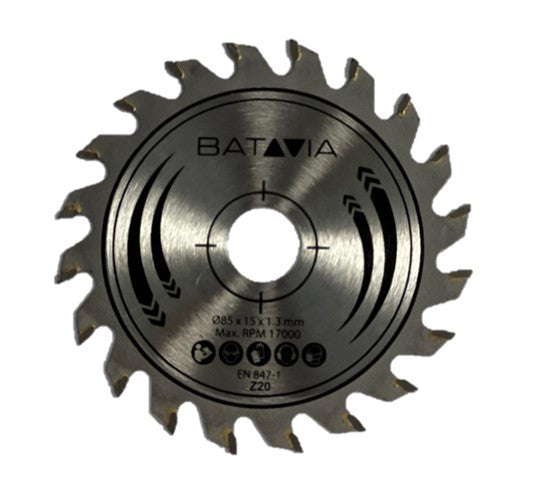
Choose a blade that matches your saw's diameter and bore and suits the material. The number of teeth determines how fine the cut is.
| Material | Blade type | Teeth |
|---|---|---|
| Construction timber, joists | Tungsten carbide wood blade, alternate top bevel | Few teeth, fast and rough |
| Skirting, mouldings, furniture timber | Fine crosscut blade | Many teeth, smooth edge |
| MDF, laminate, coated boards | Fine blade, often triple chip grind | Many teeth |
| Aluminium and plastic | Non-ferrous or plastics blade, triple chip grind | Many teeth |
Blades with a negative or low hook angle are often recommended for mitre saws. They pull less into the material and give more control. Check the blade and your saw's manual for the right diameter and maximum speed.
What to look for when choosing a mitre saw
- Cutting capacity: how wide and how high can the workpiece be at 90 and 45 degrees? Check the specifications of the saw before you buy.
- Sliding function: worth having if you often cut wide boards or floorboards.
- Mitre and bevel range: a turntable with positive stops at common angles is quicker to set.
- Blade diameter: a larger blade cuts taller material.
- Dust extraction: a port for a vacuum keeps your workspace cleaner.
- Cordless or corded: a cordless mitre saw goes anywhere, without an extension lead.
Batavia offers a cordless sliding mitre saw in the Maxxpack 18V range. It is available as a bare tool or with battery and fast charger, which is handy if you already own other Maxxpack tools.
Mitre saw or circular saw?
A mitre saw is faster and more accurate when you cut lots of pieces to length or make angles. A circular saw is better for long rip cuts and large sheets, because you move the saw over the material. Many DIYers own both: the circular saw for sheets, the mitre saw for battens, skirting and angles.
How to use a mitre saw safely
- Wear safety glasses and ear defenders, plus a dust mask when cutting MDF or creating lots of dust.
- Keep your hands at least a hand's width from the blade. Do not cut very small pieces, or clamp them securely.
- Do not wear gloves or loose sleeves that could catch in the blade.
- Check that the blade guard moves freely and springs back by itself.
Frequently asked questions about mitre saws
What is the difference between a chop saw and a mitre saw?
A basic chop saw only cuts square. A mitre saw has a turntable so you can cut angles as well. In practice, most saws sold today are mitre saws.
Do I need a sliding mitre saw?
Only if you often cut boards wider than your saw can handle without rails, such as floorboards or wide shelving. For battens, skirting and mouldings, a non-sliding saw is usually enough and takes up less space.
Can I make rip cuts with a mitre saw?
No, a mitre saw is designed for crosscuts. For long cuts along the length of a board, use a circular saw or table saw with a guide.
How often should I replace the blade?
If the blade needs more force, smokes, leaves burn marks or gives ragged edges, it is blunt. Tungsten carbide blades can often be resharpened. Replace a damaged blade with loose or broken teeth straight away.
In short: mitre saws
A mitre saw cuts wood and other materials quickly and precisely to length, square or at an angle. Choose a sliding model if you regularly cut wide boards, fit a blade that suits the material and always let the blade stop before lifting the head. For long rip cuts and large sheets, a circular saw remains the better tool.