6 minute read -
Which Saw Blade Should You Choose for Hardwood?
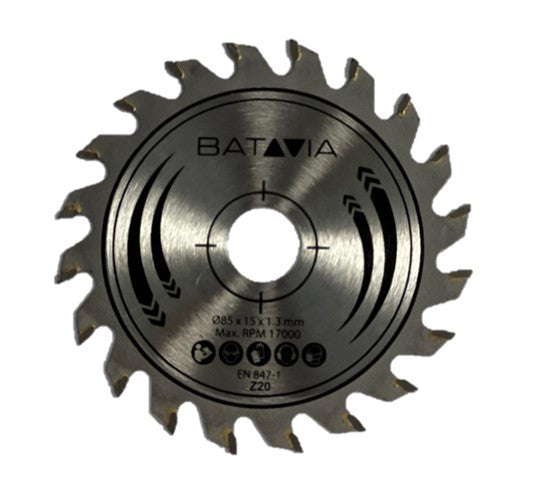
For hardwood, choose a tungsten carbide-tipped (TCT) blade that fits your machine: the same diameter, the same bore and a maximum speed rating at least as high as that of the saw. For ripping, a blade with fewer teeth works best; for crosscutting and fine work, choose a blade with more teeth.
Feed the saw at a steady pace and keep the blade sharp, otherwise the wood will burn. Below you will find how to pick the right saw blade for hardwood, from tooth count and tooth shape to size, and how to avoid burn marks.
What will you learn in this article?
- Why does hardwood need a different saw blade?
- Does the saw blade fit your machine?
- How many teeth does a saw blade for hardwood need?
- Which tooth shape suits hardwood?
- Crosscutting or ripping: which blade should you choose?
- How do you cut hardwood without burn marks?
- How do you know your saw blade is blunt?
- Is hardwood dust harmful?
- Frequently asked questions about saw blades for hardwood
- In short: saw blades for hardwood
Why does hardwood need a different saw blade?
Hardwoods such as oak, beech, meranti, bangkirai and ipe are denser and harder than softwood. You notice that in three ways:
- Wear: the teeth go blunt more quickly. A TCT blade stays sharp for much longer than a steel blade.
- Heat: a blunt blade or a slow feed makes the wood burn. You will then see black streaks on the cut face.
- Load: the machine has to work harder. A blade with too many teeth in thick hardwood can slow the motor down.
Does the saw blade fit your machine?
Always check these three things first. You will find them on the blade and in the manual for your saw.
- Diameter: use the diameter the manufacturer specifies for your saw. A larger blade will not fit under the guard and is dangerous.
- Bore: the hole in the centre must fit the arbor of your saw. Only use a reducing ring if it fits exactly and the manufacturer allows it.
- Maximum speed: the speed rating on the blade must be equal to or higher than the no-load speed of your machine.
For a cordless circular saw or mitre saw from the Maxxpack 18V range, you will find the correct blade diameter and bore in the manual or in the product specifications.
How many teeth does a saw blade for hardwood need?
The number of teeth sets the balance between speed and finish. Fewer teeth means large chips, fast cutting and a rougher cut. More teeth means smaller chips, a smoother cut and more heat.
The right number depends on the diameter of the blade. A 190 mm blade with 40 teeth cuts finer than a 305 mm blade with 40 teeth. Use these rules of thumb:
| Job | Tooth count | Why |
|---|---|---|
| Ripping (along the grain) | Low | Clears large chips, less heat |
| General purpose (crosscut and rip) | Medium | A good compromise for most jobs |
| Crosscutting and fine finishing | High | Smooth edge, little breakout |
| Beams and rough crosscutting | Low to medium | Fast work, finish less important |
If in doubt, check what the blade manufacturer lists as its intended use. It often states exactly which material and which cutting direction the blade is designed for.
Which tooth shape suits hardwood?
The shape of the teeth tells you a lot about how a blade should be used:
- Alternate top bevel (ATB): the teeth are bevelled alternately left and right. They slice cleanly through the fibres and give a crisp edge when crosscutting. This is the standard for mitre saw blades and fine wood blades.
- Flat top (FT): flat teeth that work like a chisel. Fast when ripping along the grain, but less clean when crosscutting.
- Triple chip grind (TCG): alternating trapezoidal and flat teeth. Mainly for hard materials such as laminate, plastics and non-ferrous metal, and also suitable for wood with a hard surface layer.
A negative hook angle gives less bite and is safer on sliding mitre saws. A positive hook angle cuts more aggressively and is usual on circular saws and table saws.
Crosscutting or ripping: which blade should you choose?
Crosscutting means cutting across the grain, for example cutting a hardwood decking board to length. You want a clean end without splintering, so choose a blade with a high tooth count and an ATB grind.
Ripping means cutting along the grain, for example making a board narrower. The chips are long and fibrous. A blade with fewer teeth and deep gullets clears them better and runs cooler.
If you do both, choose a general-purpose blade with a medium tooth count. Switch to a finer blade for visible work, such as furniture or a staircase.
How do you cut hardwood without burn marks?
- Use a sharp blade. A blunt blade is the main cause of burn marks.
- Keep the feed constant. Too slow causes friction and heat. Too fast slows the motor down.
- Let the machine reach full speed before the blade touches the wood.
- Clean the blade. Resin and pitch build-up add friction. A resin remover and a brush help.
- Set the cutting depth correctly on a circular saw: the blade should protrude a few millimetres below the workpiece. That means less heat and less risk of kickback.
- Support the workpiece so the cut does not close up and pinch the blade.
How do you know your saw blade is blunt?
There are a few tell-tale signs: you have to push harder, the wood burns more quickly, the cut frays more, the machine gets noisier or a carbide tip is missing. A TCT blade can be resharpened by a saw sharpening service. If the blade is damaged or more than a single tooth is missing, replace it.
Is hardwood dust harmful?
Yes, take care. Hardwood dust, such as oak and beech, can harm your airways when breathed in over long periods. Some tropical hardwoods also irritate the skin and eyes. Cut with dust extraction, wear a dust mask (at least FFP2) and safety glasses, and make sure there is good ventilation. Hearing protection is a sensible precaution with circular saws and mitre saws. Always remove the battery from the machine before changing the blade.
Frequently asked questions about saw blades for hardwood
Can I use a softwood blade for hardwood?
For a few cuts, yes, as long as it is a TCT blade. A cheap steel blade goes blunt quickly in hardwood. For regular work with hardwood, a blade the manufacturer specifies for hardwood or general woodworking is the better choice.
Which saw blade should I use for hardwood decking boards?
For cutting decking boards to length, a crosscut blade with a high tooth count works well, because the ends remain visible. If you need to rip boards narrower, switch to a blade with fewer teeth. Cut steadily, as a lot of decking timber is very hard.
What does TCT or HM mean on a saw blade?
Both mean the teeth are made of tungsten carbide (TCT stands for tungsten carbide tipped; HM is the German and Dutch abbreviation). Tungsten carbide is much harder than steel and stays sharp for longer. For hardwood, it is the standard.
How often should I have a saw blade sharpened?
That depends on how much you cut and which wood. Have the blade sharpened as soon as you need to push or you see burn marks. Do not leave it too long, as a very blunt blade gets hot and can warp.
In short: saw blades for hardwood
Choose a TCT blade with the diameter, bore and speed rating your saw requires. Use fewer teeth for ripping, more teeth with an ATB grind for crosscutting and a medium tooth count if you do both. Keep the blade sharp and clean, feed steadily and always cut hardwood with dust extraction and a mask.