6 minute read -
Cutting Coving and Mouldings: Which Saw Should You Use and How Do You Cut a Mitre?
You cut coving and decorative mouldings with a fine-toothed saw, so the cut stays smooth and the material does not crumble. For polystyrene, use a fine handsaw or a sharp snap-off knife. For polyurethane (PU, also sold as HDPS) and wood, use a fine handsaw or a mitre saw with a high tooth count blade.
The corners are cut as mitres, either in a mitre box or on a mitre saw. With the right technique, cutting coving neatly is well within reach of a confident DIYer.
What will you learn in this article?
- Which saw should you use for coving and mouldings?
- Mitre box or mitre saw?
- How to cut a mitre in ceiling coving
- How much coving should you order?
- Preparing the surface and fixing coving
- Painting coving
- Working safely with coving
- Common mistakes when cutting coving
- Frequently asked questions about cutting coving
- In short: cutting coving
Which saw should you use for coving and mouldings?
The material of the moulding decides the saw. Most coving and wall mouldings are made of polystyrene, polyurethane or wood.
| Material | Characteristics | Best saw |
|---|---|---|
| Polystyrene | Light, soft, dents easily | Fine handsaw or sharp snap-off knife |
| Polyurethane / HDPS | Harder, crisper profile, more impact resistant | Fine handsaw or mitre saw with a fine blade |
| Wood and MDF | Sturdy, heavier | Mitre saw with a fine blade or a fine tenon saw |
Cutting polystyrene coving
Polystyrene is soft and grainy. A coarse saw tears the beads loose and leaves a ragged edge. Use a fine-toothed handsaw, such as a tenon saw or a Japanese pull saw, or cut with a sharp snap-off knife in several passes. A power saw tends to be a disadvantage here: the speed can tear or melt the material.
Cutting polyurethane and HDPS mouldings
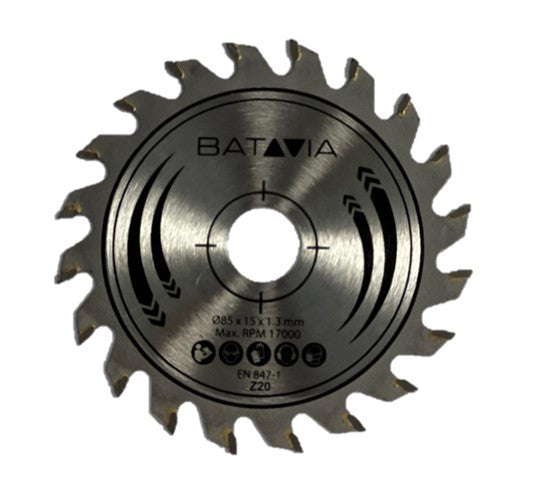
Mouldings made of polyurethane or HDPS are harder and hold a crisper profile. They cut well with a fine handsaw. If you have a lot of lengths to cut, a mitre saw with a high tooth count blade is quicker and more accurate. Batavia offers a cordless mitre saw on the Maxxpack 18V platform; fit a fine finishing blade for this kind of work. The number of teeth is printed on the blade itself, so check it before you start.
Wooden and MDF mouldings
Wooden and MDF mouldings are cut most neatly on a mitre saw with a fine blade. By hand it also works, with a fine tenon saw in a mitre box. Cut with the show face upwards if the blade cuts from the top down.
Mitre box or mitre saw?
A mitre box is an inexpensive box with saw slots at 45 and 90 degrees. For a room with four square corners and soft coving, that is enough. Make sure the moulding fits in the box, as wide coving does not always fit.
A mitre saw is quicker and more accurate, and you can set any angle. That is useful in older houses, where walls are rarely perfectly square. For hard mouldings and lots of cuts, a mitre saw is the better choice.
How to cut a mitre in ceiling coving
Coving sits at an angle between the wall and the ceiling. That is why you place it in the mitre box or on the mitre saw the way it will sit on the wall, but upside down:
- The edge that goes against the ceiling lies on the base of the box or the saw table.
- The edge that goes against the wall rests against the back of the box or the saw fence.
- Then cut at 45 degrees. On an internal corner the wall edge is the longest, on an external corner the ceiling edge is the longest.
Practise first on two offcuts and hold them together in the corner. If the joint fits, you know how to position the real lengths.
What if the corner is not 90 degrees?
Measure the corner with an angle finder or a sliding bevel with a protractor. Divide the measured angle by two: that is the mitre angle for each length. If the corner is 92 degrees, for example, cut both lengths at 46 degrees. Small gaps can be filled afterwards with decorators' caulk.
How much coving should you order?
- Ceiling coving: measure the perimeter of the room and add about 10 per cent for waste and mitres.
- Panel and wall mouldings: measure the perimeter, subtract the width of doors and windows and add about 5 per cent.
It is better to order one length too many than to run short halfway. A repeat order does not always have exactly the same profile.
Preparing the surface and fixing coving
Mouldings only bond well to a surface that is clean, dry, dust-free, grease-free and flat. If there is wallpaper on the wall, check that it is firmly stuck everywhere, or the coving will pull it off. On new plaster and other absorbent surfaces, apply a primer first. Use the adhesive or grab adhesive that the moulding manufacturer recommends. Some solvent-based adhesives attack polystyrene.
Ideally, start in the least visible corner and work from there. Join long runs with a straight butt joint or a small mitre, with a little adhesive in the joint.
Painting coving
Paint polystyrene coving with water-based acrylic paint or emulsion. Solvent-based paint can attack polystyrene. PU and wooden mouldings can also be finished with other paints after priming. Fill joints and nail holes with decorators' caulk or filler first, let it dry and then paint.
Working safely with coving
Work from a stable stepladder or a mobile scaffold tower, and ask a second person to hold long lengths. Wear safety glasses when cutting with a mitre saw and keep your hands out of the line of the cut. Remove the battery from the saw before you change the blade.
Common mistakes when cutting coving
- Using a coarse saw on polystyrene, so the edge crumbles.
- Laying ceiling coving flat in the mitre box instead of upside down and at an angle.
- Assuming every corner is 90 degrees.
- Ordering too little, so you have to make up the run with a different profile.
- Using adhesive that attacks polystyrene.
Frequently asked questions about cutting coving
Can you cut coving with a mitre saw?
Yes, especially hard mouldings made of PU, HDPS, wood or MDF. Use a blade with a high tooth count and cut without forcing. For soft polystyrene, a fine handsaw or knife often gives a neater result.
How do you cut an internal corner in ceiling coving?
Place the coving upside down and at an angle in the mitre box, with the ceiling edge on the base. Cut at 45 degrees so the long side of the coving is on the wall edge. Do the same in mirror image for the other length.
What paint should you use on polystyrene coving?
Use water-based acrylic paint or emulsion. Solvent-based paints and adhesives can dissolve or distort polystyrene.
How much extra coving should you buy?
For ceiling coving, allow about 10 per cent extra, and about 5 per cent for panel and wall mouldings. With lots of corners, or if it is your first time, one spare length is well worth having.
In short: cutting coving
Cut coving and mouldings with a fine-toothed saw: a fine handsaw or knife for polystyrene, and a fine handsaw or mitre saw for PU, HDPS and wood. Cut ceiling coving upside down and at an angle in the mitre box. Measure out-of-square corners and halve the angle, order 5 to 10 per cent extra and paint polystyrene with water-based paint.